

SEJournal Online is the digital news magazine of the Society of Environmental Journalists. Learn more about SEJournal Online, including submission, subscription and advertising information.
November 19, 2025
 |
BookShelf: The Cost of Losing Our ‘Sacred Acres’
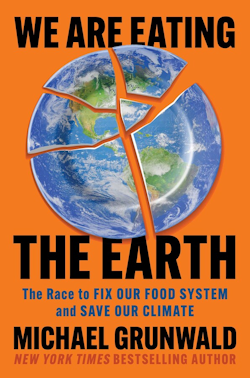
“We Are Eating the Earth: The Race to Fix Our Food System and Save Our Climate”
By Michael Grunwald
Simon & Schuster, $29.99
Reviewed by Tom Henry
 |
There are, of course, many great books about agriculture and its impact on the environment.
But there are few that match the breadth, depth and comprehensive vision of “We Are Eating the Earth: The Race to Fix Our Food System and Save Our Climate.”
Miami-based bestselling author and New York Times contributing writer Michael Grunwald has done a masterful job of reporting and storytelling with this book.
The media often focuses on one or two issues when trying to explain big agriculture’s impact on the environment, such as dealing with manure generated at concentrated animal feeding operations, or CAFOs.
Well, let’s just say that Grunwald goes far beyond jokes about methane-rich cow burps and farts, though he has some of those in this book, too.
“Ruminants are the leading source of methane from agriculture, passing 3 percent of all greenhouse gases out of their front and rear ends,” Grunwald writes. “They’re like coal plants with tails, except the U.S. has 200,000 times as many cows as coal plants, which makes controlling their emissions tougher.”
The problem of protein
He explains in a holistic way, without sounding like a PETA activist or a Sierra Club alarmist, why America’s obsession with meat, particularly beef, contributes mightily to climate change.
Grunwald explains why the situation stands to get worse as the world’s population continues to grow. It’s not simply a matter of getting people to eat more rice, either, because rice production is a significant source of methane emissions itself.
He argues that many politicians,
lobbyists and world leaders are
in denial about an inescapable
need for more protein.
He argues that many politicians, lobbyists and world leaders are in denial about an inescapable need for more protein or at least calories of some kind. Few offer answers about how to meet those rising demands as the demand for land itself becomes greater.
We’re on an unsustainable trajectory, Grunwald points out, because land is finite and it’s not free. The math of sticking with the status quo just doesn’t add up.
Can meat alternatives succeed?
Grunwald writes about trying to change his own dietary habits, but — more importantly — he walks readers through an era of get-rich-quick schemes by various startup companies, such as Beyond Meat and Impossible, and their efforts to augment society’s grocery store options with plant-based foods and meat alternatives.
He provides great insights into marketing and business acumen here, showing how some companies in the meat-alternative business have fared poorly in penetrating food markets. At the same time, others have experienced short-term success on a limited basis or, at best, modest gains for the massive investments they’ve made.
Some of those businesses, he suggests, have had anything from bad public relations to committing one of the most mortal sins of all, the creation of bad-tasting food.
Said one exec: “I told you they sucked, and they still suck! The taste, the texture, the price, the nutrition, they nailed zero out of four, and now they’re like, ‘Why did we get our asses handed to us?’”
A Dutch scientist named Mark Post, though, stated it was unrealistic to believe lab-grown cultivated meat could be produced on a scale to seriously compete with conventional meat before 2030, anyway. Post said there’s been too much hype about meat alternatives and cautioned that we’re “still at the beginning of this battle.”
Good intentions gone awry
Grunwald spends a fair amount of the book blowing away myths about biofuels and other products, such as regenerative agriculture. Some were billed as panaceas but, in his mind, have either fallen short of their promises or have been used to make corporations money by deceiving a gullible public. In other words, a ruse.
This book isn’t what I would call
an all-out assault on agriculture,
but more of one that shows
the folly of humanity.
This book isn’t what I would call an all-out assault on agriculture, but more of one that shows the folly of humanity. There are plenty of examples of good intentions gone awry, especially when human naivete, greed and the inevitable politics come into play.
Much of the book is told through the lens of someone Grunwald has known for years and come to admire, Tim Searchinger, a lawyer by trade who has dedicated much of his life toward trying to solve the mystery of feeding a growing world population while reducing the environmental impact of agriculture. He grew into becoming an obsessive researcher, not so much because of his background but because of his personality.
Land use domino effect
Not surprisingly, Searchinger realizes the root causes of many ag-based environmental impacts are land-use problems.
One obvious example is the issue of biofuels, which displaced so much farmland. That, in turn, caused more forests to be destroyed in order to make room for the displaced crops and livestock, the net result being more climate change.
The point Grunwald and Searchinger make is there is a domino effect when it comes to land use. A recurring theme is that land is finite, and it is not free.
Searchinger is now a senior research fellow at Princeton University’s Center for Policy Research on Energy and the Environment, as well as a senior fellow at the World Resources Institute.
He’s an important ally for Grunwald’s book, more than just an ordinary source. The reader follows Searchinger’s point of view over several years as a storytelling technique. Grunwald uses him to help explain myriad issues through the eyes of a single person.
Good intentions, bad science
It’s debatable if Grunwald really had to fall back on Searchinger as much as he did to advance his narrative, but there’s no doubt that Searchinger’s insight adds something to the reader’s experience.
Many of the book’s issues are involved and complex, and it’s helpful having them woven together and explained through an expert point of view to some degree.
Society hasn’t just fallen
for clever buzzwords. It’s
also fallen for bad science
with good intentions.
Grunwald, with Searchinger’s help, shows how the world not only ignored the climate crisis for too long but has made it worse by embracing feel-good ideas that aren’t as sustainable as they sound. Society hasn’t just fallen for clever buzzwords. It’s also fallen for bad science with good intentions, he claims.
It’s hard to deny the need for a fundamental shift, not just in behavior but also values, Grunwald writes.
He quotes Searchinger as saying that the challenge “will be to treat every acre of farmland and every acre of nature as sacred, because God isn’t making more of them.”
“The climate fight is not the kind of war that will end with carbon dioxide’s surrender on a battleship,” Grunwald writes in his conclusion. “There will be gratifying victories and frustrating defeats, but no final victory or defeat, just better or worse. Forests will fall and new forests will be planted. Wetlands will be drained and drained wetlands will be rewetted. But there will be a cost to every acre we lose, because land is not free, and every acre is sacred.”
Tom Henry is SEJournal’s BookShelf editor and a former board member for the Society of Environmental Journalists who created The (Toledo) Blade’s environment beat in 1993. His last review was of “Welcome to Florida: True Tales from America’s Most Interesting State.”
* From the weekly news magazine SEJournal Online, Vol. 10, No. 41. Content from each new issue of SEJournal Online is available to the public via the SEJournal Online main page. Subscribe to the e-newsletter here. And see past issues of the SEJournal archived here.
SEJ Publication Types:
Topics on the Beat:
Region:
Visibility: