

SEJournal Online is the digital news magazine of the Society of Environmental Journalists. Learn more about SEJournal Online, including submission, subscription and advertising information.
June 10, 2026
 |
BookShelf: Kelp — The Understory, Underwater
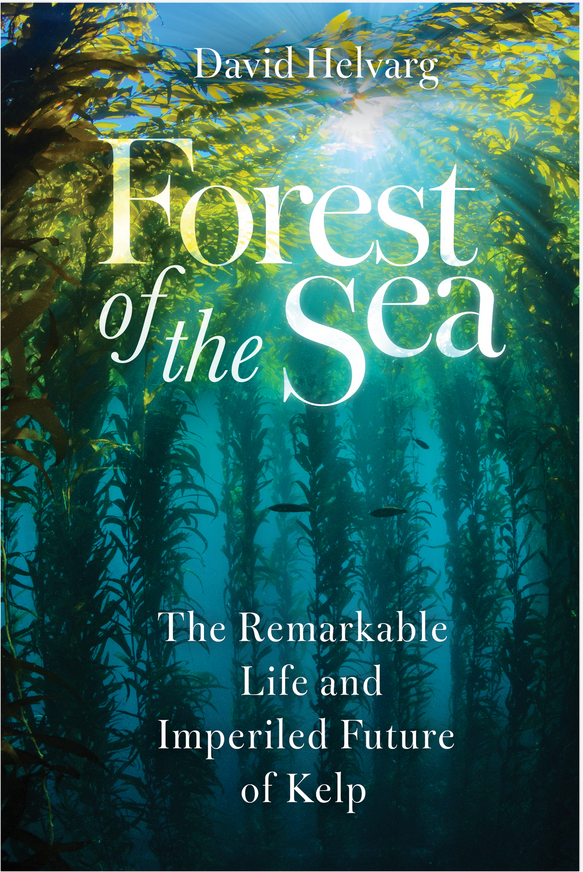
“Forest of the Sea: The Remarkable Life and Imperiled Future of Kelp”
By David Helvarg
Princeton University Press, $30.00
Reviewed by Jennifer Weeks
 |
Kelp is basically big, brown algae.
But there’s a world of difference between seeing piles of kelp tangled and swarmed by insects on a beach, and healthy kelp growing underwater.
Kelp forests line close to one-third of the world’s coasts, in cool- and cold-water zones from Alaska to the bottom of South America. They grow in dense, towering clusters that provide food, shelter and protection for fish, birds, invertebrates and more.
But they don’t get much notice, even though they’re within a day’s trip of millions of people.
In “Forest of the Sea: The Remarkable Life and Imperiled Future of Kelp,” environmental journalist and ocean advocate (and occasional SEJournal contributor) David Helvarg wants to change that — not just because kelp forests are awesome, but because climate change, overharvesting and other threats are killing kelp in many places.
Kelp forests “have declined by as much as 60 percent over the past half century as they’ve repeatedly been affected by pollution, overfishing, mechanical harvesting, and, increasingly, marine heat waves that have seen places such as Prince William Sound, Alaska, recording 76-degree water temperatures, as deadly to kelp as the 100-degree water temperatures in the Florida Keys were to reef-forming corals several years ago,” Helvarg explains.
That’s not just a problem for the many creatures that feed, grow and hide in kelp forests.
These ecosystems also provide many valuable services for humans. They protect coastlines from erosion and storm surges, and are a source of food and ingredients for products such as shampoo, beer, toothpaste and potentially many other goods.
A 2023 study estimated the value of kelp forest services at $500 billion yearly.
Vivid descriptions of dives
Helvarg takes readers underwater on kelp forest dives, and to research labs and coastal communities where people are working on kelp forest protection from many different angles.
Some are trying to enact regulations that limit overharvesting of wild kelp.
Others are culling purple urchins from the ocean floor so they won’t devour kelp forests in zones where natural predators like sea otters are absent.
Still others are raising endangered abalone, an underwater snail that helps maintain healthy kelp forests, and planting them back in the ocean in areas where they were overfished just a few years ago.
The strengths of this book are
Helvarg’s broad contacts in the
marine science world and his
vivid descriptions of dives.
The strengths of this book are Helvarg’s broad contacts in the marine science world and his vivid descriptions of dives, whether they’re for fun or to observe conservation work underwater.
Here’s an excerpt from a dive at a kelp restoration site off Rancho Palos Verdes in Southern California:
“... the rocky bottom is mostly purple, with a rich understory of seaweeds and coralline algae that takes up calcium from the water and acts like a cement holding rocks, boulders, and other bottom structures together. … I stop again, fascinated by the sight of a Norris’s top snail 5 feet up a kelp snipe (stalk), its bright orange and black mantel wrapped around the stipe and its little black eye stalks pointed up. … There are also wavy top turbans and tube worms bored into the rocks and various sponges and anemones in orange, white and brown.”
Engaging trip through a little-known world
Reading this book feels like going scuba diving: There’s a roving, somewhat random feel to it, much like swimming slowly over a reef and scanning for interesting stuff growing on the rocks or drifting past on the current.
For the most part, it works, but some spots could use a bit more structure and signposting.
For example, the narrative doesn’t pull back and give a capsule history and summary of basic kelp science until it’s four chapters and 80 pages in.
And buried on page 161, a researcher from Sonoma State University, who works on growing bull kelp in his lab, makes a really important observation about all the disparate conservation efforts that Helvarg spotlights:
“In terms of restoration efforts between the people working on otters, pycnopodia (the sunflower sea-star), abalone, and kelp, they don’t even talk to each other.”
It’s because of different funding sources, he explains, and “there’s a lot of vitriol against the otters,” which commercial fishermen see as a threat to valuable species like Dungeness crabs.
This kind of context would have been useful higher up in the story.
Overall, though, “Forest of the Sea” is an engaging trip through a little-known world right off of our shores, and Helvarg is a capable divemaster.
It’s enough to lure casual divers into chilly waters where kelp sways in the current.
Jennifer Weeks, contributing editor to SEJournal, is a freelance editor and writer and a former board member of the Society of Environmental Journalists. She was senior environment and energy editor at The Conversation US from 2015 to 2024. Her last review was of “Tigers Between Empires: The Improbable Return of Great Cats to the Forests of Russia and China.”
* From the weekly news magazine SEJournal Online, Vol. 11, No. 23. Content from each new issue of SEJournal Online is available to the public via the SEJournal Online main page. Subscribe to the e-newsletter here. And see past issues of the SEJournal archived here.
SEJ Publication Types:
Topics on the Beat:
Region:
Visibility: