

SEJournal Online is the digital news magazine of the Society of Environmental Journalists. Learn more about SEJournal Online, including submission, subscription and advertising information.
September 30, 2026
 |
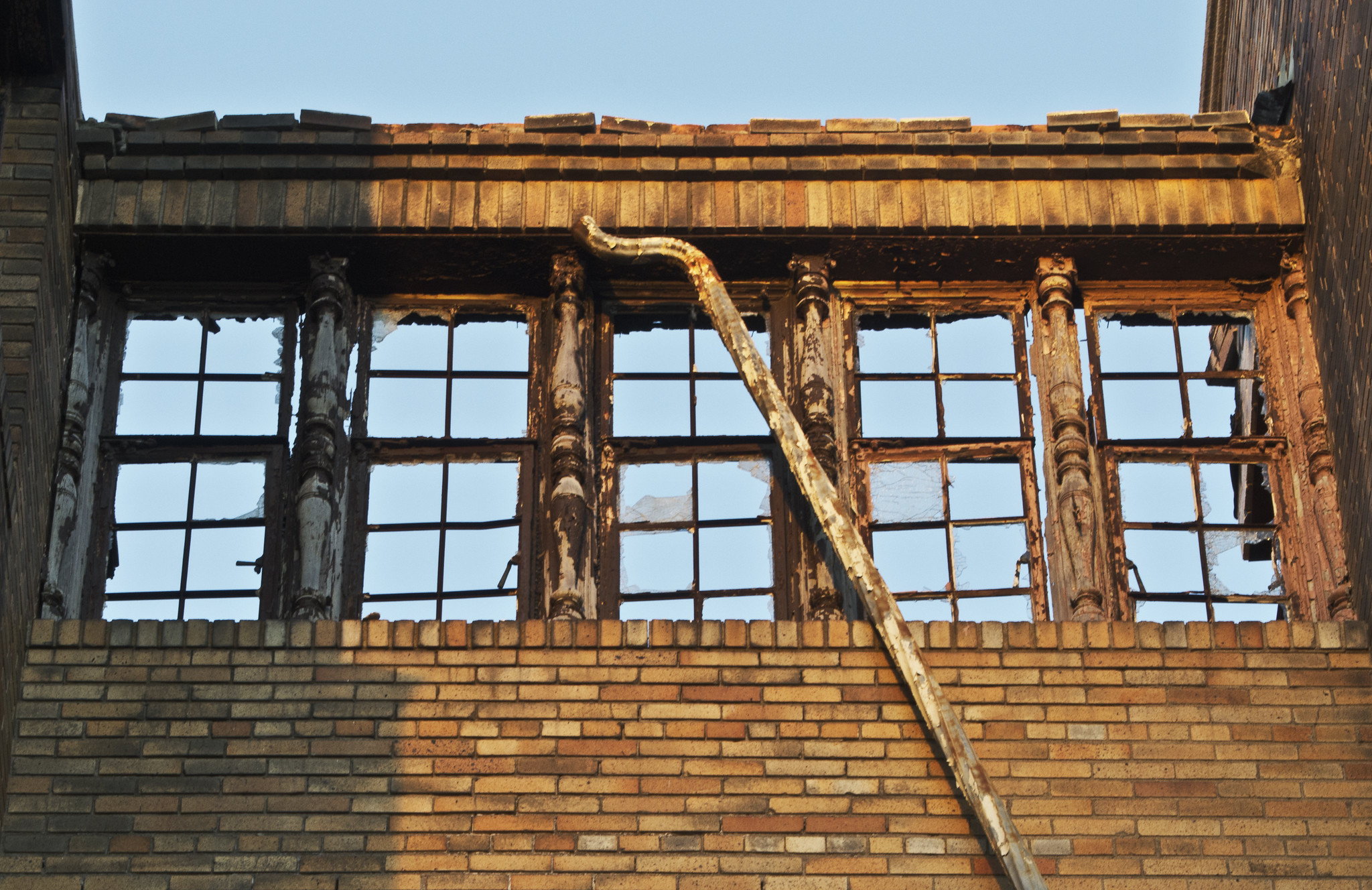 |
| A detail of Highland Towers in Highland Park, Michigan, described as a blight on the Detroit enclave, abandoned for nearly two decades before it was demolished in 2026. Photo: Dan Diffendale via Flickr Creative Commons (CC BY-NC-SA 2.0) |
Feature: Closing the Trust Gap With Environmental Justice Communities
By Dave Spratt
Environmental justice communities and journalists both work to hold power accountable and share the truth — but often work on parallel tracks with little interaction between them.
It’s a two-sided coin. Years of neglect or even malpractice by the media (see, for example, the wrongs detailed in The Kansas City Star’s six-part apology) have left environmental justice advocates and the communities they serve distrustful.
Journalists who seek to tell those
communities’ stories often don’t
know where to begin or hit
dead ends in their reporting.
And journalists who seek to tell those communities’ stories often don’t know where to begin or hit dead ends in their reporting.
To tell those stories with honesty and care, journalists must rebuild the trust of communities that have been economically overlooked and underresourced — a process that takes time and effort.
Over the past year, the Institute for Journalism & Natural Resources and Planet Detroit, an environmental justice-focused news outlet, have been working together to find ways to recast the relationship between local climate justice advocates and the news outlets that cover them.
Last September, we co-hosted the Climate Justice Journalism Summit, a convening of climate justice advocates and journalists in Detroit.
Climate advocacy leaders, including Martina Guzmán, director of the Race & Justice Reporting Initiative at Wayne State University Law School, helped shape the program’s guiding principles. And journalists and advocates were present in equal numbers, 14 of each, and paired up as “buddies” to get to know each other.
The convening was held in a closed room with no press, no audience and no recording — a safe space to speak plainly about both grievances and hopes, challenges and solutions.
The event generated a set of guiding principles for journalists who wish to build trust in environmental justice communities and report on them respectfully and truthfully. Here are the key takeaways.
Reimagine objectivity
For journalists, the standard for objectivity is often to “tell both sides” — and in many news stories that works just fine.
But that standard frequently falls apart in environmental stories, especially those that involve marginalized communities.
For example, if a multinational corporation with billions of dollars at its disposal is conducting activities that are causing health problems in nearby populations of lesser means, exactly what is gained with a “both sides” approach?
If the playing field isn’t level, a different standard of objectivity may be required.
Fortunately, journalists already have the tools they need to tell those stories truthfully and objectively: facts, supporting evidence, context and transparency.
And of course, industry sources in this instance would be included, but not centered.
Center community voices and expertise
Centering is a key element of empathic reporting on marginalized communities.
There is a huge difference between a story that centers community members and one that centers official or industry voices, a mistake that is still too prevalent in the media.
Centering community voices requires
a shift that involves believing in the
expertise and lived experience
of community members.
Centering community voices requires a shift that involves believing in the expertise and lived experience of community members who have been harmed by economic decisions and their environmental fallout.
A mother whose child suffers from asthma may not have a Ph.D. in public health, but she certainly knows how her child’s illness impacts her family’s well-being. She knows what doctors say about it. She knows her child’s symptoms and how much the medications cost. She knows how many days her child missed school. She knows how much work she has missed and what the financial implications are. That’s all expertise — with data points.
 |
| An environmental justice rally in Detroit. Photo: Marcus Johnstone via Flickr Creative Commons (CC BY-NC 2.0). |
During the convening, a participant brought up an excellent example of poor centering: A news article about an agreement between the utility DTE and the city of Highland Park, Michigan, to install solar street lighting throughout the community.
The article touted the agreement as an investment by DTE — but never mentioned that it took Highland Park residents and activists 12 years of fighting lawsuits to reach that point. Those battles took an extreme emotional and financial toll on residents, who also had to deal with the compromised public safety of living in a city in darkness. But that was all overlooked when DTE issued a press release.
That kind of institutional bias is far too common in the media and is a major driver of distrust. Quote the elected official. Quote the industry. Then throw in the reaction of a disgruntled community member, almost as an afterthought. Then wonder why the people who have been harmed aren’t eager to talk with a reporter.
Better: Start with members of the impacted community. Hear their concerns. Then put the onus on bad actors to demonstrate they’re providing safe living conditions — or to explain why they aren’t.
Be present in communities
One longstanding complaint of people in marginalized communities is the “parachute” approach to reporting, where the media ignore a community until something bad happens there, then swoop in and tell a story of woe and pain.
Newsroom leaders will argue that crime and disasters are newsworthy, and they aren’t wrong.
But it’s how those stories fit into the overall coverage of a community that bears examination.
Environmental justice advocates advise the journalists who want to provide deeper, more meaningful coverage of their communities to actually spend time there, getting to know people and gaining a better understanding of their lives.
That means being there without a deadline in mind. Attending church functions and basketball games. Being present and making yourself familiar.
A good reporter will identify themes
and activities in the community that
make excellent news stories that
reflect the community’s full set of values.
A good reporter will identify themes and activities in the community that make excellent news stories that reflect the community’s full set of values.
When those stories become a body of work that is empathic and truthful, trust begins to build. Then, when a bad-news story breaks, it can be measured against the full body of work and not just a negatively framed one-off.
Two caveats. First, it’s important to understand power dynamics within a community, which also takes time. Second, if you can’t make time for this kind of legwork — freelancers, we hear you — maybe you’re not the right person for the job.
Media challenges
Much of the discussion during the event necessarily focused on the way the media handles marginalized communities. But the participants also talked about the obstacles that journalists face, including shrinking newsrooms, increased costs for media liability and safety, time constraints and editorial pressures.
The collapse of the news industry has created profound challenges at the local level.
Some outlets have shuttered completely, and those that remain often function with a significantly reduced staff. That means the remaining reporters and editors are asked to do more work in less time. It also means high demand for breaking news in a cycle that never sleeps, which often pulls reporters away from their beats entirely.
And while it’s the reporter’s job to uncover news that bubbles out of their beat or coverage area, it’s the editor’s job to curate all the news, from all the beats, into a cohesive news package designed to serve the highest number of readers, listeners or viewers. News about communities, the environment, health and climate competes for space alongside national news, politics, sports and even entertainment.
At the end of the day, the group put together a list of things journalists who want to tell accurate, respectful and impactful stories should stop doing, start doing and keep doing. Those recommendations can be found in the Climate Justice Journalism Summit final report.
[Editor’s Note: Material for this story was drawn from a panel moderated by Spratt at the Society of Environmental Journalists’ annual conference in Chicago, Illinois, in April 2026, whose sponsors are listed here. Listen to the panel audio recording here (see Room D; SEJ members only).]
Dave Spratt is the CEO of the Institute for Journalism & Natural Resources, a nonpartisan nonprofit dedicated to helping journalists understand and report on the intersections between society and the environment. For more than 20 years, Spratt was a fixture at daily newspapers in Colorado and Michigan, writing and editing sports, features and news, nurturing young writers and staring longingly out the window where the real action was. He is a lifelong lover of the outdoors and frequent end user of clean air, clear water and healthy habitat — human and otherwise. Easily distracted by wildlife, Spratt lives just outside Ann Arbor, Michigan, where he is known to hunt, gather and rescue the occasional raptor in need. He has a B.A. in journalism from Michigan State University and a graduate certificate in nonprofit management from Eastern Michigan University.
* From the weekly news magazine SEJournal Online, Vol. 11, No. 34. Content from each new issue of SEJournal Online is available to the public via the SEJournal Online main page. Subscribe to the e-newsletter here. And see past issues of the SEJournal archived here.
SEJ Publication Types:
Topics on the Beat:
Visibility: