




SEJournal Online is the digital news magazine of the Society of Environmental Journalists. Learn more about SEJournal Online, including submission, subscription and advertising information.
December 17, 2025
 |
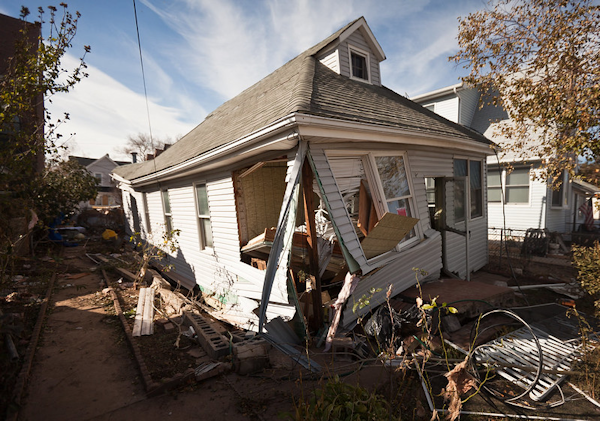 |
| A home in Staten Island, N.Y., destroyed by Hurricane Sandy in 2012. Photo: DVIDSHub/Cpl. Bryan Nygaard via Flickr Creative Commons (CC BY 2.0). |
Reporter’s Toolbox: As Realty Risk Data Is Pulled From Web, Alternatives Are Ready
By Joseph A. Davis
We learned recently, thanks to reporter Claire Brown (may require subscription) of The New York Times, that real estate listing service Zillow was removing data on climate risks from its website.
Toolbox is here to help journalists get the data anyway.
The risks of hurricanes, flooding, fires and other environmental disasters to a particular piece of real estate are worth knowing — especially for someone who’s thinking about buying it.
Because such hazards often face
whole communities, journalists
need to inform their audiences
about what could be in store.
But because such hazards often face whole neighborhoods or communities, environmental journalists need to inform their broader audiences about what could be in store.
Toolbox has reported before on most of the potential risks that buyers of real estate should watch out for: radon, arsenic and other contaminants in wellwater, adjacency to toxic Superfund sites, sea level rise, lead paint, lead pipes, asbestos and more. They are not all listed in one place. Yet.
Still, the takeaway is clear. In this era of looming and burgeoning threats, homebuyers in our audience should be wary and aware. That may mean going beyond real estate sales agents. Perhaps to the journalists.
Where the data comes from
Apparently, it was the sellers, rather than the buyers, who dropped climate risk data from Zillow.
Good thing the data is still available from the source that Zillow was using: First Street. One problem is that First Street’s address lookup is only free for a week. Bummer.
But wait. Realtor.com has most of the same data for free. You can look up any house (even your own) for free. It gets its climate risk data from First Street. Righteous!
How to use the data smartly
Remember that most of the data about climate risks is generic: The database may show the data as applying to a specific house — but it really comes from generic data for the whole block or neighborhood.
Not always, though. If you want to know more, ask if a house has been flooded, is in a flood plain or has been damaged in a hurricane.
Remember, too, that the data isn’t always comprehensive. No, the property may not be in a Federal Emergency Management Agency flood plain — but that does not tell you about the potential for combined sewers backing up during a flood event. (Hint: Homeowners can buy and install a backflow preventer.)
And it may not be the hurricane itself that threatens your house. It could be trees. If big branches overhang the house, any brisk wind could bring them down. Data won’t help.
There are still many other
climate risks that
don’t show up in the data.
There are still many other climate risks that don’t show up in the data. For example, extreme heat or cold, which can kill people. Does the home have air conditioning that works? (Not a desert cooler.) Does it have a working heater and the money to pay the bills?
So, as always, we urge you to take your reporting beyond the data. Do the shoe-leather reporting. Groundtruth everything.
[Editor’s Note: See an earlier Toolbox on turning climate risk data into stories and an Issue Backgrounder on the coming climate disaster insurance meltdown. For more on the insurance angle, see TipSheets on property risk disclosure, flood risk for homebuyers, home insurance and climate, wildfire insurance, climate financial risks and climate disaster victims, plus up-to-date headlines on insurance issues. Also, for extensive coverage of climate disaster-related issues, see our Topics on the Beat pages on disasters, climate change, wildfire and hurricanes.]
Joseph A. Davis is a freelance writer/editor in Washington, D.C. who has been writing about the environment since 1976. He writes SEJournal Online's TipSheet, Reporter's Toolbox and Issue Backgrounder, and curates SEJ's weekday news headlines service EJToday and @EJTodayNews. Davis also directs SEJ's Freedom of Information Project and writes the WatchDog opinion column.
* From the weekly news magazine SEJournal Online, Vol. 10, No. 45. Content from each new issue of SEJournal Online is available to the public via the SEJournal Online main page. Subscribe to the e-newsletter here. And see past issues of the SEJournal archived here.
SEJ Publication Types:
Topics on the Beat:
Region:
Visibility: