

SEJournal Online is the digital news magazine of the Society of Environmental Journalists. Learn more about SEJournal Online, including submission, subscription and advertising information.
April 8, 2026
 |
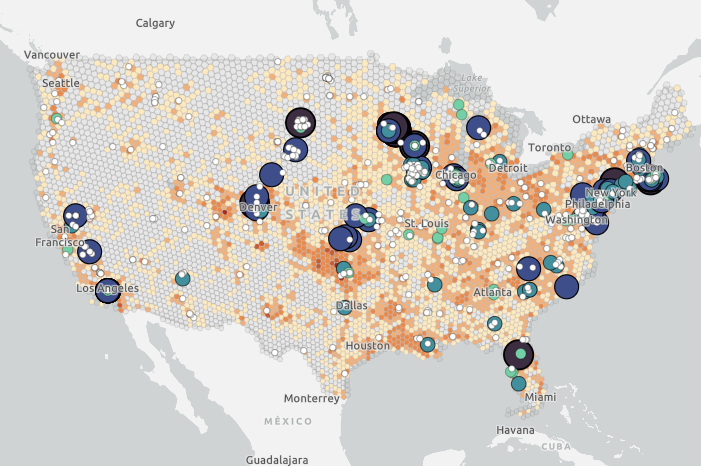 |
| A map-based PFAS locator is on offer from the U.S. Geological Survey, one of the most rigorous of U.S. science agencies. Image: USGS PFAS in US Tapwater Interactive Dashboard website. |
Reporter’s Toolbox: Report on PFAS Better, With a Better Mapping Tool
By Joseph A. Davis
PFAS are a class of some 20,000 fluorinated chemicals that can be toxic to humans and that persist in the environment. Removing them from drinking water is expensive.
The U.S. Environmental Protection Agency began regulating them under the Biden administration, and then weakened those regs under Trump 2.0.
We told you last year about a database on toxic PFAS chemicals in drinking water — one published by the Environmental Working Group.
Well, we’ve found yet another that can help environmental journalists. And this one is better, with more information, developed by the U.S. Geological Survey.
It’s called the “PFAS in US Tapwater Interactive Dashboard.” It is online in map form, and the raw data is downloadable.
Where the data comes from
The USGS is one of the most rigorous of U.S. science agencies, unpoliticized because it has no regulatory duties. Most of what it publishes has undergone the equivalent of peer review or been published in a science journal.
You will find a rough inventory of what data sources went into the dashboard. One is a comparison of PFAS in private wells with PFAS in public systems. Another is a database of PFAS concentration levels. Another is a collection of land sources of PFAS that get into water.
The USGS map approach has the advantage of helping you find PFAS facilities near you at a glance. That’s good. But when you drill down in the map, what you get is these funny hexagons, which tell you how many EPA “PFAS facilities” are in that area. Not that immediately useful (unless you are trying to get a regional view).
Much of the underlying data comes from
the EPA — often from the EPA’s ECHO
database, which has a universe
of enforcement information.
That reveals that much of the underlying data comes from the EPA — often from the EPA’s ECHO database, which has a universe of enforcement information. And that promptly leads you to the EPA’s PFAS Analytic Tools, which are themselves a bonanza.
You can get more on the many data sources that feed into the EPA Analytic database here.
How to use the data smartly
To help your audience assess just how serious (or trivial) the PFAS threat is that they face, you’d be well advised to focus on two things.
One is the exact chemical species of PFAS present in your area or its water (i.e., which ones out of the 20,000). The other is the concentration of those chemicals — the dose makes the poison, as they say.
If you intend to work with this data, we recommend that you talk to experts. That might include drinking water systems administrators, lab technicians and water system engineers. Also, university researchers looking at drinking water, public health and toxicology.
The biggest problem with PFAS in drinking water is the cost of removing it. Generally, activated carbon filters often work. These can be expensive but have the advantage of removing many other nasty contaminants as well.
As always, we recommend going beyond the data with shoe-leather reporting and talking to people on the ground. Groundtruth everything you can.
[Editor’s Note: Here’s the TipSheet on the EWG mapping tool mentioned above and more on the Biden-era rules, plus a recent Toolbox on a safe drinking water database.
To go deeper on PFAS, get started with a comprehensive primer and an Issue Backgrounder on PFAS regulation, then check out additional Toolboxes on tracking PFAS in the Toxics Release Inventory and another database, as well as on how an obscure toxic substance database was used to ID a loophole on PFAS.
We’ve also got TipSheets on PFAS in sewage sludge, and PFAS near military sites and in local drinking water. See Features on the problem of PFAS disposal for the waste industry and a call for coverage in small communities, plus Inside Story Q&As on state-level PFAS policy change, small-market beat PFAS coverage and on PFAS contamination in Europe. For more on the history of the PFAS problem, check out our earlier reports from 2022, 2021 and 2018.
And for the latest headlines on PFAS, be sure to regularly visit our EJToday headlines on the topic.]
Joseph A. Davis is a freelance writer/editor in Washington, D.C. who has been writing about the environment since 1976. He writes SEJournal Online's TipSheet, Reporter's Toolbox and Issue Backgrounder, and curates SEJ's weekday news headlines service EJToday and @EJTodayNews. Davis also directs SEJ's Freedom of Information Project and writes the WatchDog opinion column.
* From the weekly news magazine SEJournal Online, Vol. 11, No. 14. Content from each new issue of SEJournal Online is available to the public via the SEJournal Online main page. Subscribe to the e-newsletter here. And see past issues of the SEJournal archived here.
SEJ Publication Types:
Topics on the Beat:
Region:
Visibility: