

SEJournal Online is the digital news magazine of the Society of Environmental Journalists. Learn more about SEJournal Online, including submission, subscription and advertising information.
April 15, 2026
 |
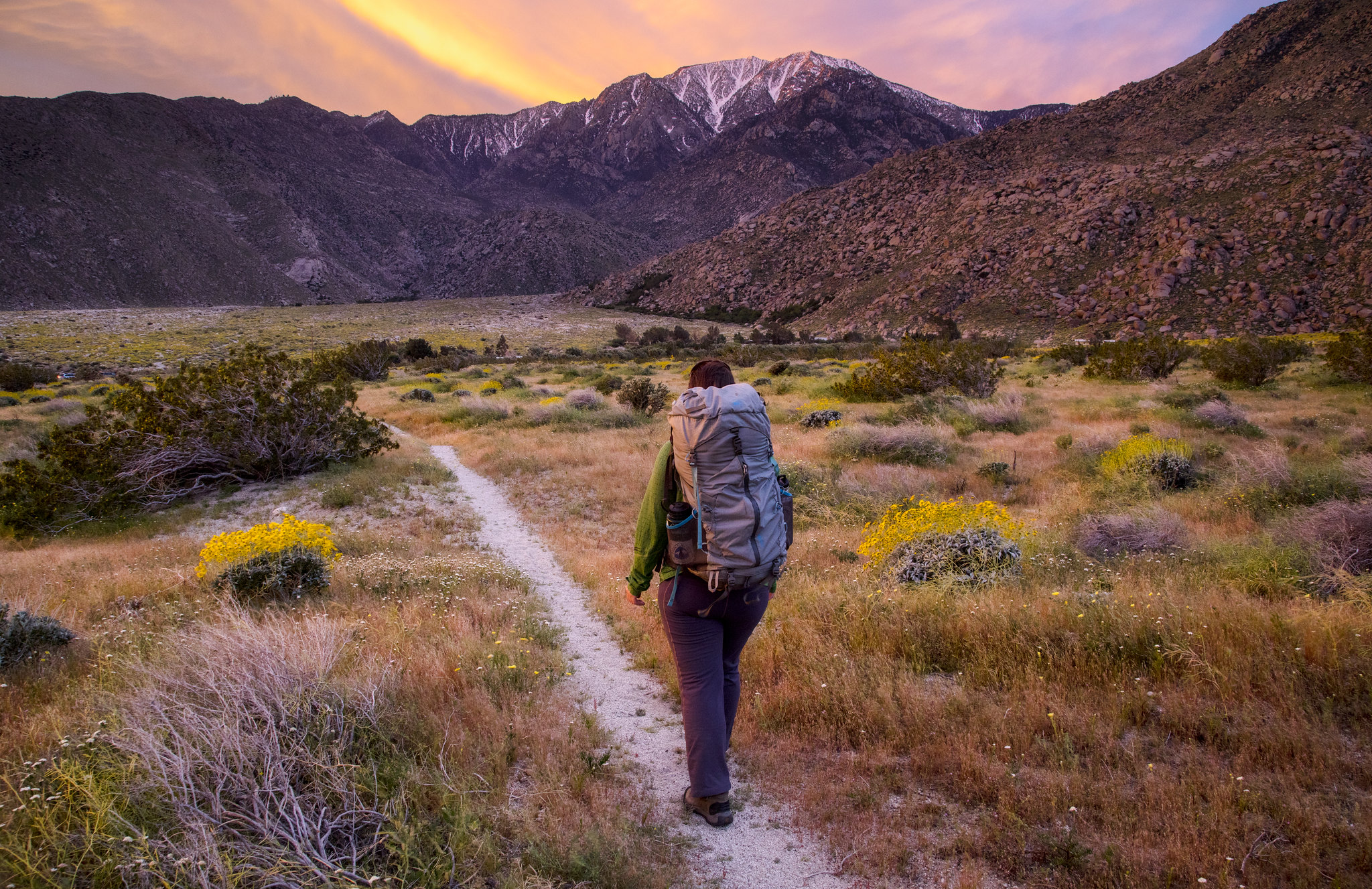 |
| A hiker on the Pacific Crest Trail, which runs from California through Oregon to Washington state, and extends into Mexico and Canada. Photo: Bureau of Land Management/Bob Wick via Flickr Creative Commons (CC BY 2.0). |
TipSheet: National Trails System — You Can Get There From Here
By Joseph A. Davis
In order to prove yourself as an environmental journalist, you may just have to put on your boots and start hiking on a national trail.
Consider it a happy, healthy and (hopefully) paid vacation. Tell your editor you have to do it for work.
It doesn’t have to be a long hike, necessarily. But it’s a good way to meet other hikers to interview.
Why it matters
The National Trails System is a treasure as valuable as Fort Knox. There are some 91,000 miles of trail in all, consisting of 1,300 trails.
There are four kinds of national trails: scenic, historic, recreational and side trails. To be officially named historic or scenic, a specific stretch of trail must be designated by Congress. Others can be designated by state and federal agencies.
Trails don’t usually get designated without near-consensus — private landowners often worry about losing control of their land. This means lots of meetings, which, of course, is where you get interviews.
The backstory
It goes back to Daniel Boone, Henry David Thoreau and John Muir, really. Read Thoreau’s essay, “Walking.”
President Lyndon B. Johnson
gets big credit for the
enactment in 1968 of the
National Trails System Act.
President Lyndon B. Johnson, who proposed the idea in a 1965 speech, gets big credit for its enactment in 1968 (before Earth Day), if only because he signed the National Trails System Act.
Actually, though, some environmental visionaries in Congress were agitating for it before then: like Sens. Henry “Scoop” Jackson and Gaylord Nelson.
Still, we think of Justice William O. Douglas leading journalists on a hike up the C&O Canal towpath in 1954.
Story ideas
- The system includes some long-distance trails, like the Appalachian Trail or the Pacific Crest Trail. Spend some time on the trails (or at a good shelter). Talk to day hikers and through hikers. Explore their culture. You may need to get a trail name.
- The system doesn’t just include hiking trails. Some are also meant for biking, paddling or historical tourism. Talk to biking and paddling groups about their experiences. The Harriet Tubman trail network on Maryland’s Eastern Shore includes a fine museum on the Underground Railroad.
- Trails are often maintained by local or regional volunteer groups, like the Potomac Appalachian Trail Club. Attend one of their maintenance events and talk to volunteers and organizers. Bring a shovel.
- Where the trail crosses a major road, there may be a handy grocery or ice cream store. Hang out there during the heat of the day and talk to hikers coming in. Put the cost of ice cream cones in your expense report.
- Not all the great trails are in the system. Find the ones near you. For example, the Register’s Annual Great Bicycle Ride Across Iowa pulls in riders from all over the United States. It’s hot in July, but there’s great support, and everyone has a blast. If you don’t go to Iowa, look for bike-touring outfitters in your area,
- Look at this map and note how many of the trails connect. That’s the cool thing about trails. Remember that many local and regional trail networks aren’t part of the system. Do yours connect? How far can you go starting just with your local bike path?
- The Anacostia Water Trail is an officially designated part of the trail system. Check it out. It’s short. But if you look … beyond, you will find it’s just one of many other (often nonfederal) water trails, which are a great way of exploring stories in your ecoregion.
Reporting resources
- Rails to Trails Conservancy: A nonprofit membership group that advocates conversion of abandoned rail rights of way into hiker and biker trails.
- American Hiking Society: A nonprofit membership and advocacy group whose members like to hike.
- National Park Service: The main agency coordinating the National Trails System. It has maps.
- Other federal agencies: Agencies like the U.S. Forest Service and the Bureau of Land Management may participate in management of National Trails.
- State parks and recreation agencies: These usually manage state trails. Find yours in this directory.
Joseph A. Davis is a freelance writer/editor in Washington, D.C. who has been writing about the environment since 1976. He writes SEJournal Online's TipSheet, Reporter's Toolbox and Issue Backgrounder, and curates SEJ's weekday news headlines service EJToday and @EJTodayNews. Davis also directs SEJ's Freedom of Information Project and writes the WatchDog opinion column.
* From the weekly news magazine SEJournal Online, Vol. 11, No. 15. Content from each new issue of SEJournal Online is available to the public via the SEJournal Online main page. Subscribe to the e-newsletter here. And see past issues of the SEJournal archived here.
SEJ Publication Types:
Topics on the Beat:
Region:
Visibility: