

SEJournal Online is the digital news magazine of the Society of Environmental Journalists. Learn more about SEJournal Online, including submission, subscription and advertising information.
April 15, 2026
 |
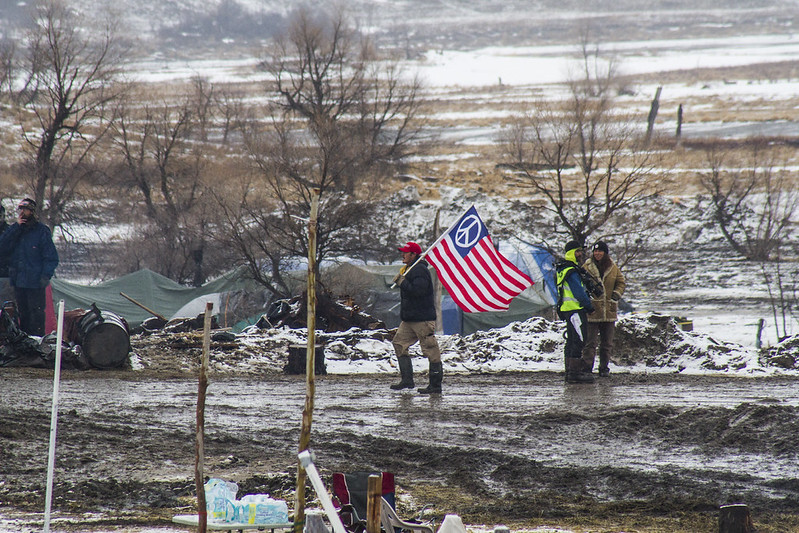 |
| A scene from the closing of the central protest site over the Dakota Access oil pipeline at Standing Rock, North Dakota, in February 2017. Photo: Dark Sevier via Flickr Creative Commons (CC BY-NC 2.0) |
Voices of Environmental Justice: Why the Silencing of Protest Matters
By Yessenia Funes
Nick Tilsen arrived in North Dakota in August 2016 to support the Standing Rock Sioux Tribe against the Dakota Access oil pipeline threatening ancient waters considered sacred by local tribes.
At the time, the Standing Rock movement hadn’t yet ballooned to national prominence. But Tilsen is a citizen of the Oglala Lakota Nation, and this is what family does. They show up for one another.
The historic protests that followed saw an unprecedented police and private security response. Tilsen, founder and CEO of the Indigenous rights group NDN Collective, was among the first to be charged with a felony (he has been arrested seven times over the years and managed to beat every charge, for a collective 60 years in prison). And he was just one of over 700 people arrested in the span of about a year.
Tilsen believes he has been politically targeted — in an attempt to silence him and chill the free speech rights of the broader Indigenous movement.
Standing Rock may have happened a
decade ago, but U.S. environmental
movements are still grappling with
the First Amendment fallout.
Standing Rock may have happened a decade ago, but U.S. environmental movements are still grappling with the First Amendment fallout across the country. State and federal governments are creating legal barriers to protests. President Donald Trump’s scorched-earth politics only add fuel to the fire.
In the face of that reality, we environmental journalists have a duty to cover the increasing criminalization of protesters, water protectors, environmentalists or however else we want to label those defending local ecosystems and communities.
SLAPP at Greenpeace
One group in particular has become a poster child for this worst-case scenario attack on free speech.
The international environmental organization Greenpeace was one of many that sent staff and resources to North Dakota at the height of the anti-pipeline protests. But it has now become the only one ordered by a North Dakota judge in February to pay $345 million for its involvement.
 |
The fossil fuel company, Energy Transfer Partners, which has brought forth several lawsuits against Greenpeace, the first filed back in 2019, blames Greenpeace for a movement it didn’t lead — Indigenous peoples and tribes did.
The suit partly revolves around Greenpeace paying for staff’s time and travel to Standing Rock, as well as fundraising efforts for the cause. In reality, the organization sent only six employees to North Dakota — a fraction of the 10,000-plus people who showed up. And its financial contributions were minor compared to the millions the Standing Rock Sioux Tribe ultimately gathered.
Despite this, the courts are trying to hold Greenpeace exclusively liable for damages resulting from the protests. The environmental group plans to appeal.
Advocates have dubbed the case a SLAPP suit, or a strategic lawsuit against public participation. Lawsuits like these aim to suck time, resources and energy from individuals and entities that are challenging a larger, wealthier individual or company. The goal of a SLAPP suit isn’t always to win; it’s to make the defendant’s life so miserable that their cause loses steam.
Over 30 states have passed anti-SLAPP statutes to prevent this. North Dakota is not one of them.
“One of the big farces about the whole Greenpeace thing is the administration wanted to take an attack on the environmental movement,” Tilsen said. “They also wanted to try to erase the fact that Standing Rock was an Indigenous-led movement.”
Eco-criminalization taken to the next level?
All this mirrors a new approach from the Trump administration. In September, the president issued two executive actions, one of which prohibits “material support,” or financial contributions, to so-called domestic terrorist groups.
Alleen Brown, an independent reporter and senior editor at Drilled, has been following Standing Rock since the beginning. She’s alarmed by the parallels between Trump’s federal actions and the criminalization of water protectors.
“As reporters, we should be really
looking for ways to uncover
what is happening there.”
— Alleen Brown, Drilled
“As reporters, we should be really looking for ways to uncover what is happening there,” Brown said.
A private company is suing Greenpeace, but its actions are in line with the pro-fossil fuel right’s wider attempt to stifle free speech. Trump wants to treat protesters — and the individual nonprofits that support them — even more harshly.
Since Trump started his second presidency over a year ago, the president has expanded the definition of domestic terrorism. His September executive actions targeted groups and individuals who label themselves anti-fascist or anti-capitalist.
Trump has already used this language to criminalize victims who dared to defy him and his administration’s actions. After Immigration and Customs Enforcement officers killed U.S. citizens Renee Nicole Good and Alex Pretti in Minneapolis in January, the Trump administration quickly labeled them terrorists, though officials backtracked those statements after coming under public scrutiny.
“If they misuse the T-word, as I call it, then that gives them the right to go after any materials or the right to surveil you,” Tilsen said. “They got the green light to do whatever they want, essentially. They can violate your rights in the pursuit of protecting the American public and American citizens when the reality is that the only ones being protected are these transnational corporations violating people’s rights.”
Surveillance is especially relevant to protesters and organizers. Trump’s September memo also directs the FBI’s Joint Terrorism Task Forces to essentially investigate groups and individuals that challenge the administration’s agenda.
During Standing Rock, this task force sent informants into camps and monitored participants. Brown wonders if Trump’s memo invites even more scrutiny on Indigenous-led efforts, especially its language around “anti-Americanism.” Would the administration define tribal land back efforts as “anti-American,” for instance? Who gets to decide?
Waves of anti-protest measures
In the decade since Standing Rock and Trump’s first presidency, 22 states have enacted 55 laws restricting the public’s right to protest.
Elly Page, senior legal adviser for the International Center for Not-for-Profit Law, began tracking these bills in 2017 after her team noticed more states introducing such legislation. "Then, it became clear that it was not a temporary phenomenon,” she said.
She’s not sure if the rise can be attributed solely to the Standing Rock protests — the center only began keeping tabs on the bills afterward — but one pattern is undeniable. "We've seen waves of legislation in response to different protest movements,” Page said, pointing to the 2020 Black Lives Matter uprisings and the pro-Palestinian college encampments of 2024.
Journalists shouldn’t ignore how
this affects their climate beat.
Our sources are affected by this.
So is the public.
Journalists shouldn’t ignore how this affects their climate beat. Our sources are affected by this. So is the public and their right to a healthy and safe environment.
“A critical component of the struggle for climate justice is people's ability to join together and speak out about the climate crisis and about the need to protect the planet,” Page said. “As the space for lawful protest shrinks or is eroded, it's essential that people know that this is happening."
And Standing Rock isn't the only environmental movement where this has occurred, explained Dov Korff-Korn, managing attorney of the Lakota People’s Law Project, which represented and defended many water protectors over the years.
In Atlanta, land defenders faced off against police forces three years ago to stop Cop City, a 171-acre law enforcement training facility whose construction required tearing down forests. One protester charged with alleged arson was still dealing with the aftermath as recently as March. In December, charges were finally dropped against 61 others who were charged with conspiracy. And in Nevada, a mining company also sued a group of Indigenous people opposing a lithium mine a few years ago.
Fighting these allegations costs money and time — two luxuries not all environmental activists have. "Many of the people who are resisting extractive industry don't live a life of money pursuit,” Korff-Korn said. “Their life is the land, whether they're Indigenous or allies. They're not in it for the money."
Many times, these stories do boil down to money. One of Brown’s recent investigations exposed the ways fossil fuel company Enbridge wants to pay local police to protect a new dirty pipeline in Wisconsin. When a private company is paying public servants, who are they actually protecting? Is it the public’s right to free speech? Or a corporation’s right to pollute?
Journalists have a duty to expose that truth. The public can’t always figure it out without us.
Here are more tips and resources for those interested in learning more:
- Eco Files: Brown’s newsletter is a must for any journalist who wants to keep up with all her reporting. She’s the only one covering this issue with such detail and depth.
- Public records requests templates: To expose how states are crafting these new laws and why, journalists have to sometimes ask for records. Brown says filing these requests is more of an art than a science, but she suggests trying the National Freedom of Information Coalition’s templates available online. MuckRock also offers assistance online.
- Legal filings: Brown recommends journalists keep up with the legal filings of local cases they’re interested in. Material shared during discovery can help shed light on interesting leads that make for important reporting. PACER is best to access those.
- ICNL’s Protest Law Tracker: This database has every bill, passed or failed, that has attempted to limit protest. It breaks down legislation by location or issue area. If you only want to look at laws punishing those targeting infrastructure, you can filter for that. Want to see what states are expanding their definition of terrorism? It’s got that too. I’ve turned to this database repeatedly in the 10 years since it launched.
Yessenia Funes is an environmental journalist who has covered the justice beat for a decade. She publishes a creative climate newsletter called Possibilities. Funes has written for publications like Atmos, Vogue, Vox, New York magazine, The Guardian and more. Her approach to storytelling amplifies the voices of those on the front line of our present-day ecological crises. Her reporting has taken her to the West Bank, remote Indigenous communities in Nicaragua, the hostile desert of the American Southwest and post-Hurricane Maria Puerto Rico.
* From the weekly news magazine SEJournal Online, Vol. 11, No. 15. Content from each new issue of SEJournal Online is available to the public via the SEJournal Online main page. Subscribe to the e-newsletter here. And see past issues of the SEJournal archived here.
SEJ Publication Types:
Topics on the Beat:
Region:
Visibility: